
What Is a Crypto POS System? The Complete Guide for Businesses (2027)
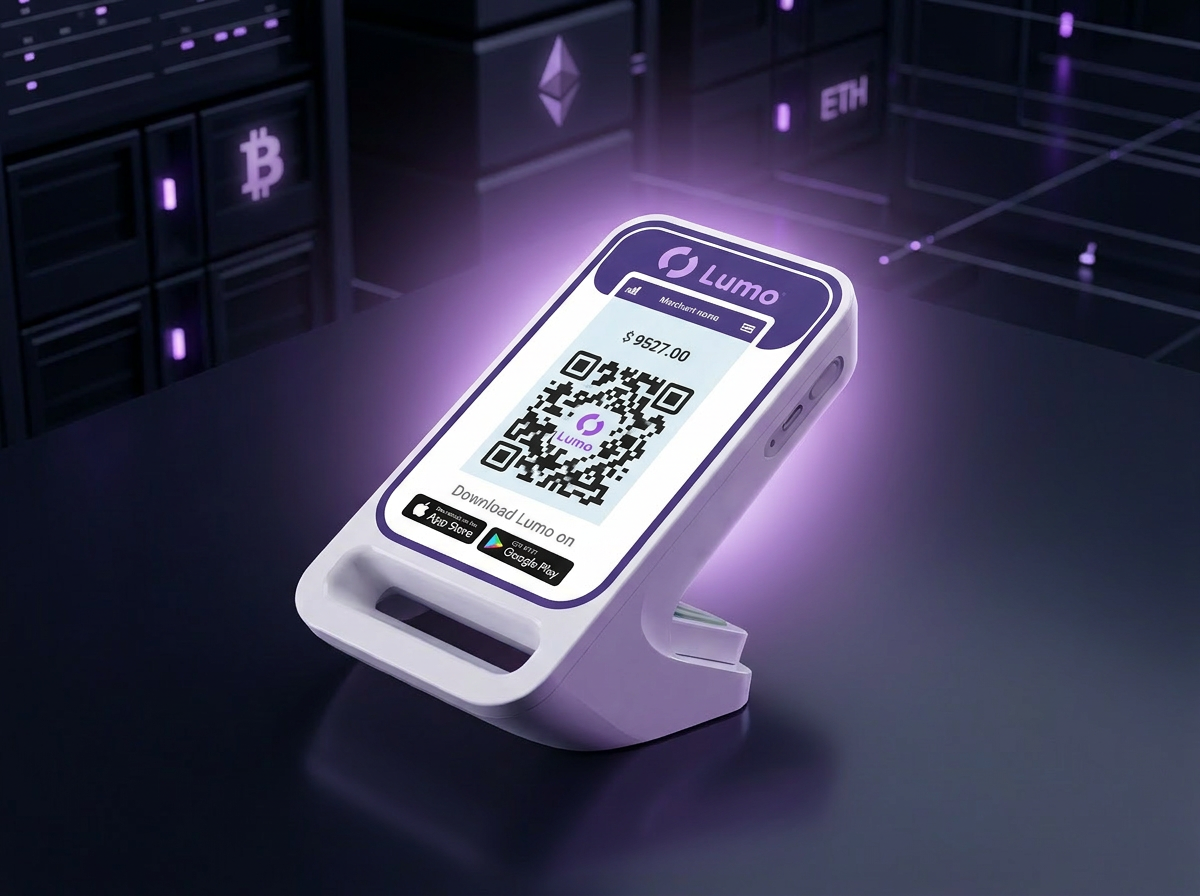
A crypto POS system — short for cryptocurrency point of sale — lets businesses accept digital asset payments directly from customers, in-store or online, without banks, card networks, or the fees that come with them. With Lumo POS launching in Q1 2027, here's everything you need to know about how these systems work and why forward-looking businesses are making the switch.
What Is a Crypto POS System?
A crypto POS system is a payment terminal or software platform that enables merchants to accept cryptocurrency as payment at the point of sale. Unlike card terminals that route transactions through Visa, Mastercard, or banking networks, a crypto point of sale system settles payments directly on the blockchain — peer to peer, with no middlemen involved.
When a customer pays with crypto, the merchant's POS generates a payment request — usually a QR code or near-field communication (NFC) prompt. The customer scans it with their crypto wallet, confirms the amount, and the transaction is broadcast to the relevant blockchain. Within seconds to a few minutes (depending on network congestion), funds arrive in the merchant's wallet — settled, final, and irreversible.
No chargebacks. No 3–5 business day holds. No percentage skimmed by a processor. That's the core value proposition of a cryptocurrency point of sale system in 2027.
How Does a Crypto Point of Sale Work — Step by Step?
The mechanics are simple, even for businesses new to crypto:
- Customer selects crypto at checkout — they choose to pay with Bitcoin, Ethereum, or another supported asset.
- POS generates a payment request — the system calculates the crypto amount at the current market rate and displays a QR code (or triggers NFC).
- Customer scans and confirms — using their mobile crypto wallet, the customer approves the exact amount.
- Blockchain confirmation — the transaction is broadcast on-chain and confirmed by the network. This takes seconds on networks like Tron (TRX) and XRP, or a few minutes on Bitcoin.
- Funds hit the merchant wallet — settlement is immediate. No waiting period. No clearing house. The crypto is yours.
Non-custodial systems like Lumo POS go a step further: funds go directly into a wallet you control. The platform never holds your money — ever.
Crypto POS vs. Traditional POS: What's the Difference?
Traditional card terminals come with a hidden cost structure that most business owners accept without question. Here's how a crypto POS system compares:
| Feature | Traditional POS | Crypto POS (Lumo) |
|---|---|---|
| Transaction fees | 2–4% per sale | 0% |
| Settlement time | 3–5 business days | Seconds to minutes |
| Chargebacks | Yes — costly and frequent | None — blockchain is final |
| KYB requirements | Weeks of paperwork | No KYB required |
| High-risk merchants | Mostly declined | Accepted |
| Custody of funds | Held by bank/processor | Non-custodial — yours only |
| Global payments | Fees + FX conversion | Borderless, no FX fees |
The financial case is clear. For a business turning over $50,000 a month, switching from a 3% card processor to a 0% crypto POS saves $1,500 every month — $18,000 per year — that goes straight to the bottom line.
Why Businesses Are Moving to Crypto Point of Sale Systems
1. Zero Transaction Fees
Every card payment you take costs you money. With crypto, the blockchain network fee (gas) is negligible — and with Lumo POS, we absorb the complexity entirely. Your business pays 0% on every transaction. That's not a promotional rate. That's the model.
2. Instant Payouts
Traditional processors batch settlements and release funds on a delay. With crypto, settlement is near-instant and doesn't depend on banking hours, weekends, or clearing schedules. Your cash flow is immediate.
3. No KYB, No Barriers
Traditional merchant accounts require extensive Know Your Business (KYB) verification — documentation, review periods, and the constant risk of account termination. Many businesses are simply denied: online gaming operators, IPTV providers, adult content platforms, supplement brands, forex brokers. For these industries, a crypto POS system with no KYB is not a nice-to-have. It's the only viable option.
Lumo POS was built with these businesses in mind. No KYB. No approval waiting period. No arbitrary risk classifications.
4. Mastercard-Backed Infrastructure
Crypto POS systems have historically lived at the edge of mainstream commerce — tolerated but not integrated. Lumo changes that by building on Mastercard infrastructure, giving businesses and their customers the reliability of a globally recognised payments network combined with the economics of blockchain.
5. Self-Custody — You Control the Funds
Unlike custodial payment processors that hold your funds and can freeze accounts, a non-custodial crypto POS means only you hold the private keys to your business wallet. No platform can block your money. No account can be suspended. Your revenue is yours, always.
What Cryptocurrencies Can Businesses Accept?
At launch, Lumo POS supports the four most widely used payment-grade blockchains:
- ₿ Bitcoin (BTC)The original and most recognised cryptocurrency. Widely held by customers globally.
- Ξ Ethereum (ETH)The backbone of Web3, with billions in daily transaction volume and massive merchant adoption.
- ⬡ Tron (TRX)Ultra-fast, near-zero fee transactions — ideal for high-volume retail environments.
- ✕ XRPBuilt for payments. XRP settles in 3–5 seconds with negligible fees, making it excellent for point of sale.
Additional networks are planned post-launch. Businesses can accept any or all supported currencies — Lumo handles the conversion complexity on the backend.
Who Is a Crypto POS System Right For?
A crypto point of sale system works for virtually any business that takes payments — but it's particularly compelling for:
- High-risk businesses — IPTV providers, online casinos, adult platforms, forex/trading, nutraceuticals
- E-commerce stores — add a crypto payment plugin to your existing checkout
- Retail merchants — accept crypto in-store alongside traditional payment methods
- International businesses — eliminate currency conversion fees and cross-border friction
- Subscription businesses — accept recurring crypto payments without chargeback risk
- Hospitality & events — quick, final transactions with no reversals
If your business has been declined by Stripe, PayPal, or traditional card processors — or if you're simply tired of paying 2–4% per transaction — Lumo POS was built for you.
How to Choose a Crypto POS System
Not all crypto payment terminals are equal. When evaluating options, ask these questions:
- What are the fees? Some providers charge 0.5–1% per transaction. Others charge flat monthly fees. Lumo POS charges 0%.
- Is it custodial or non-custodial? Custodial systems hold your funds and can freeze accounts. Non-custodial means you always control your money.
- What KYB/KYC is required? If your business is high-risk, you need a provider with minimal or no verification requirements.
- Which networks are supported? More networks means more flexibility for your customers.
- How fast is settlement? Check the average confirmation time for each supported network.
- Does it integrate with existing systems? Look for plugins that connect to your e-commerce platform or existing checkout flow.
Introducing Lumo POS — Launching Q1 2027
Lumo POS is Lumo Wallet's dedicated point-of-sale solution for businesses — built on the same non-custodial architecture that powers the Lumo Wallet app.
It combines everything a business needs to accept crypto payments in 2027:
- 0% transaction fees — every sale, always
- Instant payouts directly to your non-custodial wallet
- No KYB required — open to all merchants including high-risk
- Mastercard infrastructure for mainstream reliability
- Support for BTC, ETH, TRX, and XRP at launch
- Website plugins for e-commerce integration
- Full self-custody — your private keys, your funds
Lumo POS is currently in pre-launch with early access available via the waiting list. Businesses that join now get priority onboarding when we go live in Q1 2027.
Ready to accept crypto payments for your business?
Join 68+ businesses already on the Lumo POS waitlist. Be first when we launch Q1 2027.
Join the Waitlist →Frequently Asked Questions
What is a crypto POS system?
A crypto POS (point of sale) system is a payment terminal or software solution that allows businesses to accept cryptocurrency as payment from customers — in-store or online. Transactions settle directly on the blockchain, bypassing banks and card networks entirely.
How does a cryptocurrency point of sale work?
When a customer pays, the POS generates a payment request (typically a QR code or NFC signal). The customer scans it with their crypto wallet and approves the transaction. Funds are sent directly on-chain and confirmed within seconds to minutes depending on the network.
Does a crypto POS system require KYB?
It depends on the provider. Lumo POS requires no KYB (Know Your Business) verification, making it accessible to businesses that have been rejected by traditional payment processors — including high-risk merchants in industries like IPTV, online gaming, and more.
What cryptocurrencies does Lumo POS support?
At launch, Lumo POS supports Bitcoin (BTC), Ethereum (ETH), Tron (TRX), and XRP — with additional networks planned post-launch.
Is a crypto payment terminal the same as a crypto POS?
Yes — a crypto payment terminal and a crypto POS system refer to the same concept: hardware or software that enables merchants to accept cryptocurrency payments at the point of sale.
When does Lumo POS launch?
Lumo POS is scheduled to launch in Q1 2027. You can join the early access waitlist at mylumoapp.io to secure priority onboarding.
Related Articles